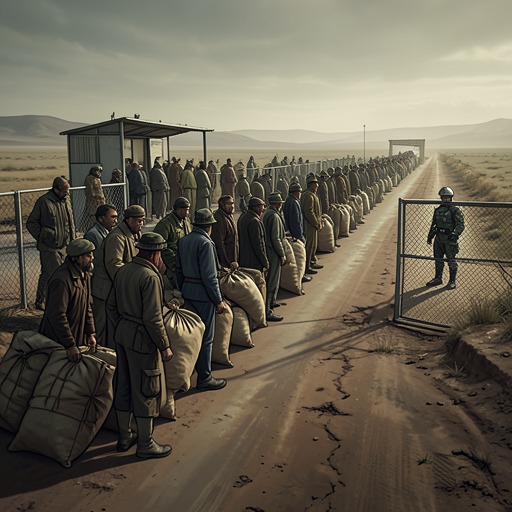
Nury Televaldi
World War ZNury Televaldi is a Kashi-based smuggler whose testimony reveals how the outbreak traveled through the ordinary channels of globalization: forged documents, tourist flights, cargo routes, ships, refugees, and international medical commerce. Interviewed in Lhasa amid celebrations after a major election, he speaks with the practical knowledge of a criminal intermediary and the retrospective unease of someone who recognized that the business he helped expand had become inseparable from the catastrophe itself.
Identity and Background
Nury Televaldi describes himself first as an importer rather than a shetou. Before the outbreak, overland smuggling was expensive and difficult, requiring passports, fake tour buses, contacts, and protection across borders. The profitable routes ran toward Thailand or Myanmar, while Kashi offered only access to the former Soviet republics, destinations few people wanted. His earlier trade dealt in whatever could be sold: raw opium, uncut diamonds, and human beings, including girls and boys. He presents this history without claiming innocence, but also without pretending that the outbreak created his criminal world from nothing; it transformed an established trade in commodities and people into an emergency industry.
The outbreak changed the scale and clientele of his work. Offers arrived not only from the liudong renkou but from respectable citizens with homes, careers, and social standing to lose. Urban professionals, private farmers, and low-level government officials sought escape, often without caring where they would be taken. Nury had heard rumors and knew that an outbreak had occurred somewhere in Kashi, although the government quickly suppressed public knowledge of it. His testimony therefore places him at the intersection of official concealment and popular suspicion: he did not possess complete information, but he understood that something was seriously wrong before the authorities admitted it.
Smuggling the Living and the Infected
Nury had limited experience with air transport, moving renshe on a few cargo flights to Kazakhstan or Russia. He contrasts his small operations with the eastern provinces, especially Guangdong and Jiangsu, where thousands were being moved each week. Air smuggling became a lucrative service for wealthy clients who could purchase prearranged travel packages and first-class tourist visas. They would land in London, Rome, or San Francisco, check into hotels, spend a day sightseeing, and then disappear into illegal residence networks. Nury had wanted to enter that business, whose profits depended on making privileged escape look like ordinary international tourism.
The trade initially tried to protect itself from infection. Air shetou avoided clients showing advanced symptoms, since a visibly infected passenger could expose the operation and attract scrutiny. The governing rule was that a traveler had to fool the smuggler before attempting to fool foreign immigration officials: the client had to look and act completely healthy, while everyone involved raced against the incubation period. Nury recalls a wealthy businessman who had suffered a minor bite, one of the slow burns that could miss major blood vessels. The couple reached a hotel room in Paris just as the husband collapsed, turning an apparently successful escape into a concealed outbreak far from China.
Flight 575 changed the calculations. Restrictions tightened, but unevenly, and airline smugglers adapted rather than disappeared. Nury repeats their maxim that “every rich man’s house has a servant’s entrance,” a phrase that turns social hierarchy into an escape route: the wealthy were not necessarily stopped by the main gates of law, because money supplied hidden access. The line also captures the moral structure of his testimony. The crisis did not erase privilege; it converted privilege into mobility, secrecy, and the ability to transfer danger elsewhere.
Maritime smuggling carried a different danger. Nury’s coastal associates had to fear an infected passenger breaking restraints and contaminating an entire hold. He has heard of ships stopping at deserted coasts and unloading infected renshe wherever land was available, whether or not it was the intended destination. Other captains allegedly headed into open water and threw entire groups overboard. He connects these practices to early reports of swimmers and divers disappearing and to stories of dead people walking out of the surf, although he insists that he never personally had to manage such a shipment.
His own breaking point came with a truck carrying a wealthy investment banker from Xi’an and the banker’s extended family. Moans came from the trailer, fists struck the aluminum walls, and the vehicle swayed under the struggling bodies. The banker’s Armani suit was torn and rumpled; scratch marks crossed his face, and his eyes carried the frantic intensity Nury had begun seeing more often. In the cab, the driver displayed the same dawning realization as Nury: money might soon lose its power. Nury slipped the man an additional fifty and wished him luck, an act that was neither rescue nor absolution but the only assistance he believed remained possible. The incident convinced him to quit.
The Hidden Medical Route
Nury also offers a disturbing explanation for outbreaks that began without an obvious bite. In the early stages, he says, nobody understood that an organ from a newly infected person might carry only an infinitesimal trace of the agent. Implanted into another body, that trace could take days or weeks to reach the bloodstream, allowing the recipient to appear healthy while infection developed unseen.
He places this possibility within China’s prewar organ industry. Elements of the Chinese army had already made millions from organs taken from executed political prisoners, and Nury argues that a new virus would not necessarily interrupt a profitable system. Hearts could be removed soon after death, or even while a victim was still alive, then packed in ice and flown to Rio. He imagines infected corneas, pituitary glands, kidneys, donated eggs, sperm, and blood entering the international market. His conclusion is broader than the familiar story of illegal immigration: if people died suddenly, reanimated without being bitten, or produced clusters of disease in hospitals, the medical supply chain might have carried the outbreak as effectively as any border crossing.
The force of this account lies partly in its uncertainty. Nury does not claim a complete epidemiological record; he asks what might explain otherwise disconnected cases. Yet the speculation exposes the same structural vulnerability as his smuggling stories. Global systems designed to move valuable bodies, organs, money, and clients efficiently had no built-in mechanism for recognizing a threat that was invisible during transit.
A Witness to Collective Panic
Nury’s testimony belongs to a larger mosaic of witnesses who describe fear moving through populations faster than reliable knowledge. In Kuwait City, Saladin Kader remembers people jeering at the Israeli ambassador’s warning about African rabies and voluntary quarantine, dismissing the account as a Zionist lie because it came from a hated enemy. Elsewhere, a televised report on the Cape Town outbreak became an opportunity for Breckinridge Scott, who treated fear as a commodity and promoted Phalanx as a preventive vaccine. When later reporting revealed that there was no wonder drug, he blamed the journalist for pulling the rug from under the market and causing the Great Panic.
Nury’s account supplies the logistical underside of that same denial. People fled while governments suppressed information, smugglers screened symptoms to protect profits, and desperate families converted every available resource into a passage out. The outbreak therefore spread through both disbelief and belief: some refused to accept the danger, while others accepted rumors strongly enough to risk forged travel, packed ships, and unsafe routes.
The consequences became visible on a mass scale. Gavin Blaire, surveying an American evacuation route from a D-17 combat dirigible, saw traffic extending to the horizon: sedans, trucks, buses, recreational vehicles, tractors, a cement mixer, and even a flatbed carrying a giant “Gentlemen’s Club” billboard with people riding on top. The road was littered with luggage, boxes, furniture, abandoned cars, and a smashed grand piano. At a maritime escape point, refugees crowded a shoreline lit by inland fires, swam toward ships, and filled the surf with those who failed to reach them. Hundreds of small boats demanded everything the refugees possessed in exchange for passage.
Narrative Significance
Nury’s importance is not that he controls the whole history of the outbreak, but that his criminal expertise makes invisible connections legible. He shows how a local disease became a global event through routes that predated the crisis and were already organized around unequal access: the poor faced dangerous overland journeys, while wealthy clients vanished from first-class hotels; the desperate were abandoned on beaches or thrown into the sea, while capital purchased concealment; and organs moved through supposedly humanitarian channels whose origins could be obscured.
His testimony also anticipates the postwar reordering of power. Five million people from the United States eventually reached Cuba, alongside refugees from Latin America, Africa, and western Europe, and were placed under the Quarantine Resettlement Program. Cuba became the “Arsenal of Victory,” serving as a breadbasket, manufacturing center, training ground, air hub, and major naval repair base. The crisis that once made Nury’s escape business flourish ultimately helped turn international movement, labor, and logistics into the foundations of new political and economic arrangements. His story begins with people trying to disappear across borders and ends, in the wider historical pattern he helps reveal, with societies forced to decide how strangers will be received, controlled, exploited, or incorporated.